

Cactus & Succulent Society
of New Zealand (CSSNZ)
Fibonacci in C&S
Fibonacci the person and some history ... who?
 Skip the history lesson!
Fibonacci was born in the city (or at that time - the state) of PISA, around 1170 AD - the exact DOB is unknown.
In the 12th century, Europe from emerging from the "Dark Ages", improved techniques in farming led to increased food
production and hence an ability for the population to increase, as well as trading of excesses. Contacts with eastern
civilisations were being made by crusaders, traders and merchants.
Many cities in Italy were independent republics surrounded by high walls due to the struggle between the Papacy and the
Holy Roman Empire. They had substantial trading enterprises and some became centres of higher learning with universities.
Into this republic or state of Pisa, Fibonacci was born
His Father, a state official associated with the new mercantile class that had emerged from the commercial revolution,
represented the mercents of Pisa at the port of Bugia, now called Bejaia (in Algeria), so Fibonacci was educated in
North Africa by the Moors.
He also traveled widely to Egypt, Syria, Greece, Sicily, as well as other parts of Africa.
During this time period Europeans used the Roman Numerical system of numbering ( I , II , III , IV , V ... X etc) as seen
today at the end of many films! (MCMXCV = 1995).
Fibonacci educated in North Africa was introduced to the Hindu-Arabic system of numbering (1 , 2 , 3 , 4 , 5 , 6 , 7 , 8 , 9), which along with the symbol of 0 (zero), meant any number could be written easily.
In 1200 Fibonacci (aka Leonardo of Pisa, Filli Bonacci (son of Bonacci) or Leonard Bigollo (Bigollo means literally "Good for nothing traveler")) ended his travels and returned to Pisa, where in 1202 he wrote his first book, about the Hindu-Arabic decimal system and introduced the use of Arabic numbers into Europe as used by us today.
He did this by introducing to western Europe the new numbering system that had been used in the Middle East & the Orient, and explaining it's superiority over the Roman Numerical system that had been taught throughout Europe before the 13th century.
All this brought widespread interest and hence importance to Fibonacci which brought him to the attention of the Holy
Roman Emperor - Fredrick II (notice royalty sticks to roman numerals!), taking part in mathematical tournaments ordered
by the Emperor.
Fibonacci went on to write about four more books, mainly solving mathematical riddles of the day - one of his most
famous being the rabbit problem below and its sequence named after him (but about which he placed little importance in).
After 1228 there is only one known document which refers to Fibonacci, this is a decree in 1240 made by the republic of
Pisa in which a salary is awarded to "the serious and learned Master Leonard Bigollo ... for services to the city on
matters of accounting and teaching its citizens".
He has been described as the most outstanding western mathematician of the Middle Ages and a man very much in advance of
his time, having profound influence on art, architecture, geometry and mathematics.
(Not everyone was happy with the new numbers and in 1299 Florentine merchants issued an ordinance prohibiting the use of
Hindu-Arabic numbers as it was too easy for an unscrupulous person to fraudulently alter numbers (e.g. 99 to 88) which
was near impossible in the Roman number system.)
The Fibonacci sequence
Think of the mathematical problem: A pair of rabbits are enclosed in a yard. How many pairs of rabbits would there be each
month, if it is supposed that every month each pair breeds and produces a new pair which from the second month on become
reproductive?
The answer: 1,1,2,3,5,8,13 ...
This is the Fibonacci sequence
It can be worked out by starting with 1 and 1, then add the previous 2 numbers to get the next number in sequence:
1,1,2 ... (2+1=) 3 ... (3+2=) 5 ... (5+3=) 8 ... (8+5=) 13 ... (13+8=) 21 ... and so on
1 , 2 , 3 , 5 , 8 , 13 , 21 , 34 , 55 , 89 , 144 , 233 , 377 , 610 , 987 , 1597 , 2584 , 4181 , 6765 , 10946 , 17711 , 28657 , 46368
... 12,586,269,025 (50th) ... 354,224,848,179,261,915,075 (100th) ... and so on infinitim
Fibonacci in Nature
Fibonacci numbers or patterns are found in:
Sea Shells, Petals on Flowers, Sunflower seed Heads, Pine Cones, Palms, Pineapple and other Bromeliads,
and Plant Growth or leaf/petal arrangements in 90% of plants.
Some Fibonacci numbers in nature are:
Buttercups ... 5 Petals
Lillies & Irises ... 3 Petals
Delphiniums ... 8 Petals
Corn Marigolds ... 13 Petals
Asters ... 21 Petals
Daisies ... 34 or 55 (or even 89) Petals
Some common trees with their Fibonacci leaf arrangement numbers are:
1/2 elm, linden, lime, grasses
1/3 beech, hazel, grasses, blackberry
2/5 oak, cherry, apple, holly, plum, common groundsel
3/8 poplar, rose, pear, willow
5/13 pussy willow, almond
Sunflower flowerhead:
The seeds form spirals (patterns that the eyes sees) curving both to the left and the right, counting the spirals gives
you 2 Fibonacci numbers
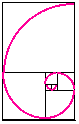
Golden spiral - Milky Way, DNA, Whirlpools, rams horns, Tornados, Fingerprints, Shells all exhibit the golden spiral
which is a direct derivative of Fibonacci numbers.
Fibonacci in Cactus & Succulents


Mammillaria, Notocactus, Gymnocalycium, Rebutia and Ferocactus all exhibit Fibonacci sequences in their rib count or tubercule arrangement.
For example: Mammillaria lloydi has 8/13 spirals, and Mam. sempervivi has 13/21 spirals when counting in counter/clockwise directions.
The Golden Ratio
The Parthenon, Stars on Flags, the great pyramids in Egypt all exhibit the Golden Ratio
Dividing two sequential numbers gives us:
1/1 = 1 , 2/1 = 2, 3/2 = 1.5 , 5/3 = 1.6666 , 8/5 = 1.6 , 13/8 = 1.625 , 21/13 = 1.615 , 34/21 = 1.619 .....
these divisions are converging, as you go further into the sequence, onto the number
1.618 or Phi (or 0.618 phi)
1.618034 is the golden ratio, golden section, golden mean or golden number as used by Greek Architects in building the Parthenon, the Egyptians in building the Pyramids, Leonardo Da Vinci in his art, it is used in musical harmony and even manifests itself in the share market cycle and its indexes.
360 degrees in a circle multiplied by 0.618 = 225.5 degrees ( 137.5 degrees left over) - the Fibonacci angle.
this is the angle between each successive leaf etc on a plant.
This angle means that leaves above do not hide leaves below so ensuring maximum sunlight to all leaves, and rain is
caught by the most leaves and channeled to the soil and hence roots.
In the sunflower flowerhead above, each new seed is phi (0.618) of a turn from the last one and there are Phi (1.618)
seeds per turn.
In seed heads this angle gives optimal packing - no crowding in the centre and not too sparse at the edge.
The Human Body
The more symmetrical your face the more healthy and attractive you appear, there is even a ratio that determines
"attractiveness" and that ratio is 1:1.618.
On a "beautiful" face the mouth is always 1.618 times the width of the nose, and the width of the mouth is 1.618 times
the distance from the corner of the mouth to the corner of the face.
Very few faces fit the 1:1.618 ratio !!!
A person with a "perfect" body, when standing, the distance from the floor to navel is 1.618 times the distance from
navel to top of head.
The bones between the knuckles in the fingers show the same ratio with the longest bone being 1.618 times the length of the
middle one, which is 1.618 times the length of the end bone.
Where to now .... ?
Phyllotaxis is the study of plant patterns produced.